
NASCAR PENALTY DRAMA: Denny Hamlin Overcomes Costly Infraction to Win the Pennzoil 400 — But What Really Happened?
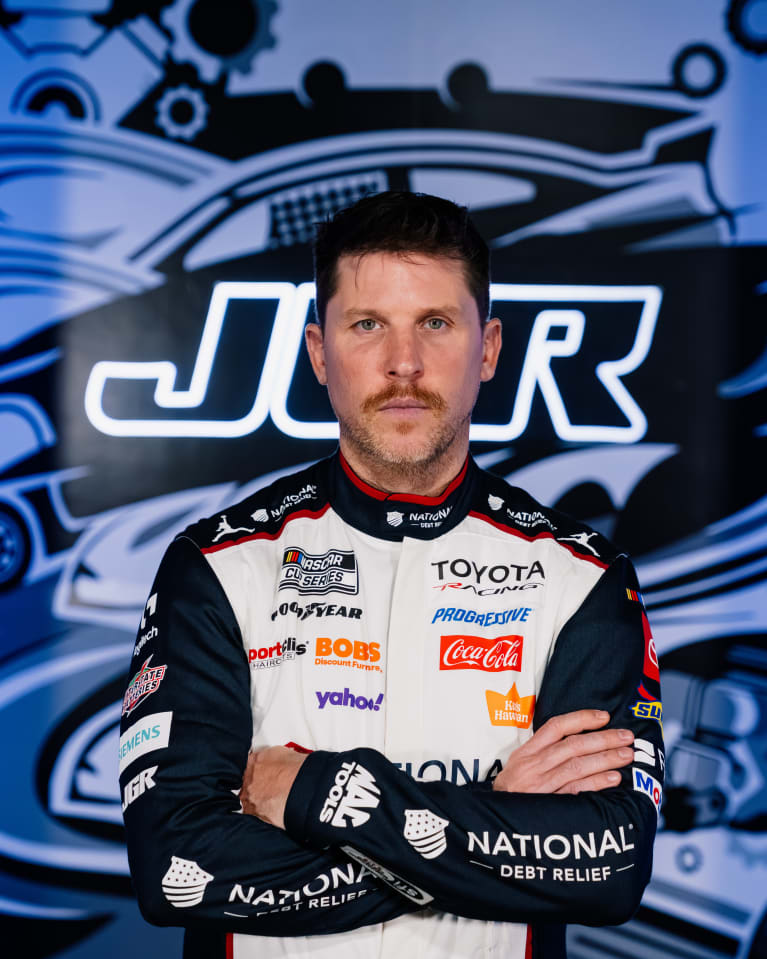
The NASCAR world erupted after Denny Hamlin’s dramatic Pennzoil 400 victory at Las Vegas Motor Speedway, but the story behind the win was far more complicated.
Hamlin did receive a penalty during the race, immediately raising questions about whether the Joe Gibbs Racing veteran had thrown away an opportunity to reach Victory Lane.
But contrary to sensational claims circulating around the story, NASCAR did not accuse Hamlin of cheating or illegally creating the advantage that ultimately carried him to victory.
The actual infraction was straightforward: Hamlin was penalized for speeding on pit road during the caution period following the conclusion of the opening stage.
That mistake sent the No. 11 Joe Gibbs Racing Toyota backward through the field and forced one of NASCAR’s most experienced drivers to begin climbing forward again.
Instead of giving Hamlin an advantage, the penalty did exactly the opposite.
It took track position away from him.
And that is where the real drama began.
Hamlin had already demonstrated that his Toyota possessed serious speed, but recovering from a pit-road penalty at Las Vegas was never going to be automatic.
He restarted 21st on Lap 89, suddenly surrounded by traffic and facing a long road back toward the drivers who had controlled the front of the field.
For a less experienced competitor, the setback could have changed the entire afternoon.
Hamlin treated it as another problem to solve.
Lap after lap, the No. 11 began moving forward.
There was no magical shortcut and no immediate return to the lead.
Hamlin simply began passing cars.
By the conclusion of Stage 2, he had climbed all the way back to fifth position, effectively erasing much of the damage caused by his earlier mistake.
That recovery became one of the defining elements of the race.
Hamlin had made an error.
NASCAR had penalized him.
Then he responded on the racetrack.
It was exactly the kind of performance that has defined Hamlin throughout a Cup Series career stretching across multiple generations of NASCAR competition.
Mistakes happen.
What separates contenders from everyone else is what happens afterward.
For Hamlin, the answer was speed.
A lot of it.
As the race entered its decisive final stage, the No. 11 Toyota once again became a serious threat at the front.
Hamlin moved into second place behind William Byron following the final-stage restart.
Then came the move that changed the complexion of the race.
On Lap 185, Hamlin drove underneath Byron and took the lead.
Suddenly, the driver who had been buried in 21st after his penalty was back where he had wanted to be all afternoon.
At the front.
Hamlin began creating separation, demonstrating the kind of long-run strength that made his car extraordinarily difficult for the competition to match.
But Las Vegas was not finished producing drama.
On Lap 211, Byron moved ahead in Turn 3 shortly before Connor Zilisch spun exiting Turn 4, triggering the race’s first on-track incident caution.
That caution reset everything.
The field came to pit road.
Christopher Bell’s crew delivered a fast stop, allowing Bell to emerge with the lead while Hamlin exited in second position.
Byron and Chase Elliott followed.
Kyle Larson, another major contender throughout the afternoon, suffered a slower stop and fell to eighth for the restart on Lap 218.
Once again, Hamlin needed to respond.
He did not wait long.
Only one lap after the restart, Hamlin moved past his Joe Gibbs Racing teammate Bell and reclaimed the lead.
This time, he refused to surrender it.
Behind him, the competition remained fierce.
Elliott began closing.
Every lap brought the Hendrick Motorsports Chevrolet closer, creating the possibility that Hamlin’s remarkable recovery could still end in disappointment.
Hamlin had been in painful situations before.
Nobody needed to remind him.
Only months earlier, his pursuit of the 2025 NASCAR Cup Series championship had ended in devastating fashion at Phoenix Raceway.
Hamlin had been only three laps away from finally capturing the championship that had eluded him throughout his otherwise extraordinary Cup Series career.
Then a caution changed everything.
The championship disappeared.
Hamlin later acknowledged that recovering emotionally from the defeat required time.
For someone who had spent decades competing at NASCAR’s highest level, even he needed to rediscover the desire to climb behind the wheel.
Las Vegas offered another test.
This time, Hamlin had the lead.
Elliott was coming.
The laps were disappearing.
And there would be no room for another mistake.
Hamlin kept the No. 11 Toyota in front.
When the checkered flag finally waved, Elliott was only 0.502 seconds behind.
But behind was all that mattered.
Hamlin had won.
The victory represented far more than another trophy.
It was his first win of the 2026 season and the 61st Cup Series victory of his career.
That number carried historical significance.
Victory No. 61 moved Hamlin beyond Kevin Harvick on NASCAR’s all-time Cup Series wins list and into sole possession of 10th place.
For a driver whose championship résumé remains unfinished, the career victory total continues to make an increasingly powerful argument about his place in NASCAR history.
Hamlin has never been shy about wanting more.
More victories.
More opportunities.
And, above everything else, the Cup Series championship that continues to represent the largest missing piece of his remarkable career.
But Las Vegas demonstrated something perhaps equally important.
He could still dominate.
Hamlin led a race-high 134 laps.
That statistic matters when examining claims that his victory resulted from some mysterious or unfair advantage.
The race itself tells a different story.
Hamlin was fast.
He made a pit-road mistake.
He was penalized.
He lost track position.
Then he drove back through the field.
NASCAR’s official race report described precisely that sequence.
There was no announcement that Hamlin’s victory had been stripped.
There was no post-race declaration accusing Joe Gibbs Racing of cheating to manufacture the winning advantage.
Instead, Hamlin remained the winner.
That distinction is critical because NASCAR penalties can vary dramatically depending on the nature of an infraction.
Some penalties happen during races.
Speeding on pit road is one of the most familiar examples.
Drivers are required to remain below NASCAR’s prescribed pit-road speed, with timing systems used to determine whether a competitor has exceeded the allowable limit.
When a driver speeds, NASCAR can issue an immediate penalty.
That was Hamlin’s problem at Las Vegas.
He paid for it during the race.
Post-race technical violations are an entirely different matter.
Those can involve inspection failures, prohibited modifications, engine issues, weight requirements, aerodynamic components, or other areas regulated by NASCAR’s extensive rule book.
Serious violations can produce major consequences.
Points can disappear.
Crew chiefs can be suspended.
Teams can receive enormous fines.
Playoff points can be removed.
In certain circumstances, victories can lose some of their postseason benefits.
Hamlin himself knows how severe those penalties can become.
In 2024, his No. 11 team received an L2-level penalty related to NASCAR’s engine inspection requirements following an earlier Bristol victory.
That case resulted in significant points deductions and a substantial crew-chief fine.
But that historical penalty should not be confused with what happened during the 2026 Pennzoil 400.
They were different races.
Different circumstances.
Different violations.
At Las Vegas, Hamlin’s documented penalty was for pit-road speeding.
And he overcame it.
That makes the real story arguably more impressive than the sensational version.
There is no need to invent cheating allegations when the actual comeback already contains everything necessary for a dramatic NASCAR story.
A veteran entered Las Vegas trying to rebuild momentum after one of the most painful defeats of his career.
He found himself with arguably the strongest car.
Then he made a mistake.
NASCAR punished him.
His afternoon could have unraveled.
Instead, Hamlin fought back.
Twenty-first became fifth.
Fifth became second.
Second became first.
And first eventually became Victory Lane.
That is NASCAR.
The margin between triumph and disaster can be microscopic.
One mile per hour too fast on pit road can destroy track position.
One slow pit stop can eliminate an advantage built across dozens of laps.
One caution can erase a multi-second lead.
One restart can change an entire season.
Hamlin understands that reality better than almost anyone.
He has benefited from NASCAR’s unpredictability.
He has also been devastated by it.
Las Vegas happened to become one of those afternoons when Hamlin overcame the chaos rather than becoming its victim.
The victory also sent a message to the rest of the Cup Series garage.
At 45, Hamlin was not simply hanging around.
He remained capable of controlling races.
His 134 laps led provided overwhelming evidence.
And perhaps most importantly, he demonstrated that setbacks did not have to become race-ending moments.
The pit-road penalty could have become the story.
Instead, the recovery became the story.
That distinction says something about Hamlin’s longevity.
Young drivers often possess extraordinary raw speed.
Veterans survive through a combination of speed, knowledge, patience, adaptability, and the ability to understand how races evolve.
Hamlin possesses all of those qualities.
Las Vegas demanded nearly every one of them.
He needed speed to move through traffic.
He needed patience after restarting deep in the field.
He needed confidence to attack once he returned to contention.
And he needed execution when Elliott closed during the final run.
There was also an emotional element to the victory.
Hamlin admitted afterward that the crushing championship loss at Phoenix had affected his enthusiasm for racing.
That admission made Las Vegas especially meaningful.
He had rediscovered something.
Not simply the ability to win.
He already knew he possessed that.
He had rediscovered the enjoyment and focus required to continue pursuing victories after experiencing one of the most painful defeats imaginable.
That may become significant as the 2026 season progresses.
NASCAR careers are rarely defined by one race.
Even championship seasons contain terrible afternoons.
What matters is how drivers respond across months of competition.
Hamlin’s Las Vegas performance provided an early reminder that he remained capable of responding aggressively when circumstances turned against him.
The fans watching understood it.
Some celebrated.
Others undoubtedly groaned.
Hamlin has always been one of NASCAR’s most polarizing personalities.
He has supporters who admire his confidence, intelligence and ability.
He also has critics who enjoy seeing him lose.
But both groups keep watching.
That is part of what makes Hamlin such a significant NASCAR figure.
He creates reactions.
And the Pennzoil 400 created plenty.
The strongest reaction, however, should be based on what actually happened.
Hamlin was penalized.
Yes.
But the penalty was not evidence that NASCAR caught him cheating his way to victory.
It was a pit-road speeding infraction.
The punishment came immediately.
Hamlin then had to recover from it.
That recovery required passing cars legitimately under racing conditions until he returned to the front.
By the end of the afternoon, NASCAR had a winner.
Denny Hamlin.
No secret post-race advantage was required to make the result dramatic.
The stopwatch, scoring monitor and finishing margin supplied enough drama already.
Hamlin crossed the line only 0.502 seconds ahead of Elliott.
Half a second.
After hundreds of miles, countless decisions and one costly penalty, approximately half a second separated victory from second place.
That is how close NASCAR can be.
And that is why accuracy matters when telling these stories.
“Cheating” is an explosive word in motorsports.
It suggests deliberate rule-breaking intended to gain an unfair competitive advantage.
Such an accusation should require evidence.
In this case, the official account provides a much clearer description.
Hamlin sped on pit road.
NASCAR penalized him.
He restarted 21st.
He recovered.
He led 134 laps.
He held off Elliott.
And he won the Pennzoil 400.
That is the story.
And for Hamlin, it may have been exactly the kind of victory he needed.
Not easy.
Not flawless.
Earned despite a mistake.
Victory No. 61 arrived with adversity attached to it, perhaps making the afternoon even more satisfying for a veteran who has experienced almost everything NASCAR can offer.
There will be more controversies.
There will be more penalties somewhere in the Cup Series garage.
There will undoubtedly be more dramatic headlines involving Hamlin before his career ends.
That comes with being one of NASCAR’s biggest personalities.
But Las Vegas should be remembered for what happened on the racetrack.
A mistake threatened Denny Hamlin’s race.
NASCAR punished him for it.
And instead of allowing the penalty to define his afternoon, Hamlin climbed back through the field and changed the ending himself.
No cheating bombshell was required.
The truth was dramatic enough.
Denny Hamlin was penalized.
Denny Hamlin went backward.
Denny Hamlin came charging back.
And when the checkered flag finally fell over Las Vegas Motor Speedway, Denny Hamlin was still the man standing in Victory Lane.
